
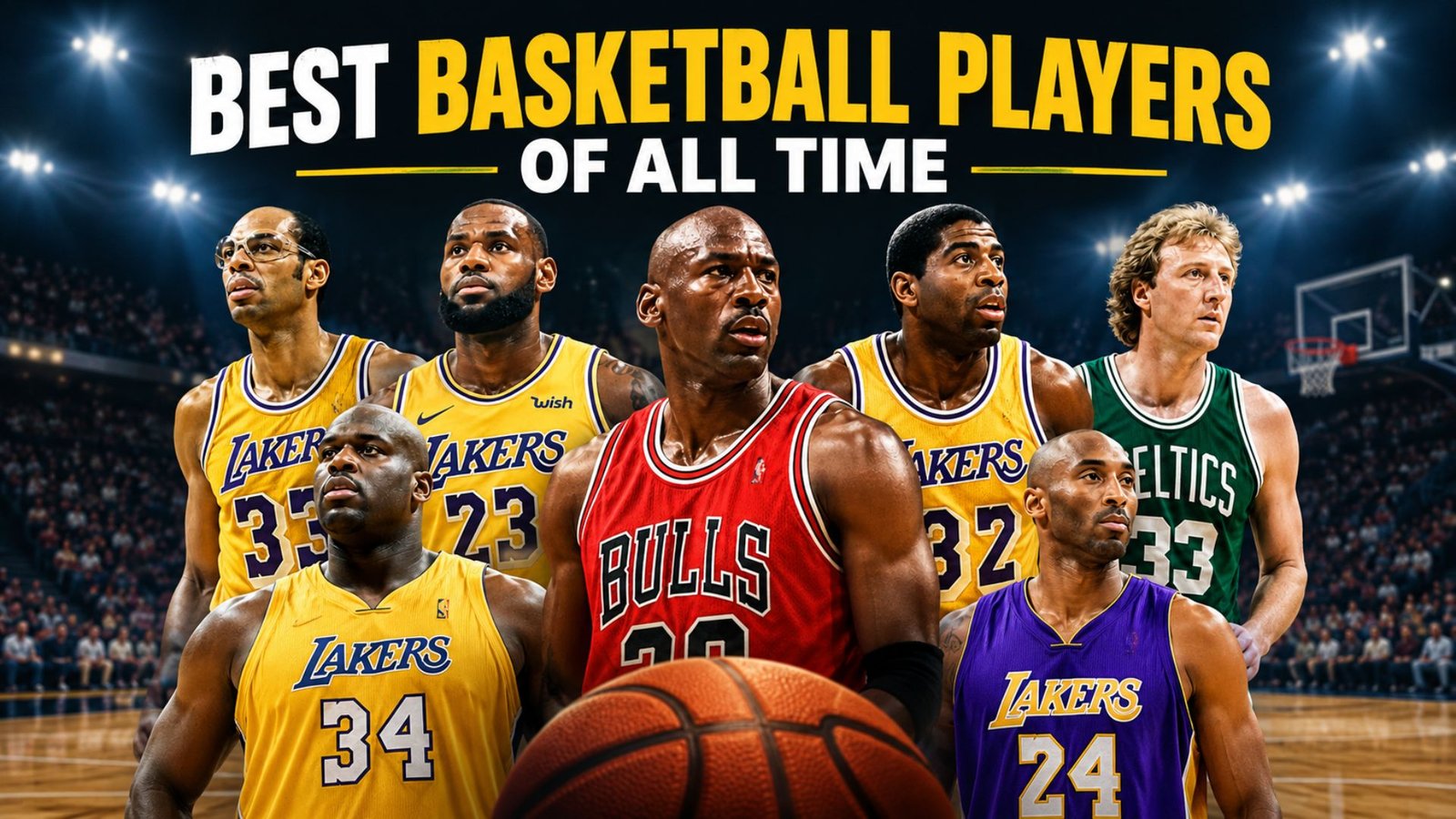
Who deserves the title of basketball’s greatest player? Fans debate Michael Jordan’s championship dominance, LeBron James’s longevity, Kareem Abdul-Jabbar’s incredible career, and the exceptional skills of legends from different generations. Choosing the greatest can be difficult without comparing their achievements. This guide ranks the best basketball players of all time by considering championships, individual awards, scoring, defense, peak performance, consistency, and lasting influence on the game.
How We Ranked the Best Basketball Players of All Time
A fair ranking requires more than scoring totals or championship rings. Basketball has changed dramatically, from the physical style of earlier decades to today’s fast-paced, three-point-focused game.
This ranking considers six important factors:
- Individual excellence: MVP awards, All-NBA selections, scoring titles, and other major honors.
- Championship success: NBA titles, Finals performances, and contributions to championship teams.
- Peak performance: How dominant a player was at their best.
- Longevity: How long the player maintained an elite level.
- Two-way ability: Contributions to both offense and defense.
- Influence: Tactical innovation, cultural impact, and importance to basketball history.
The ranking is an editorial assessment rather than an official NBA list. Players from different eras cannot be compared perfectly, so reasonable fans may disagree about individual positions.
Top 10 Best Basketball Players of All Time
The following table highlights ten players whose careers combine exceptional talent, achievements, consistency, and influence.
| Rank | Player | Position | Championships | Regular-Season MVP Awards |
|---|---|---|---|---|
| 1 | Michael Jordan | Shooting guard | 6 | 5 |
| 2 | LeBron James | Forward | 4 | 4 |
| 3 | Kareem Abdul-Jabbar | Center | 6 | 6 |
| 4 | Magic Johnson | Point guard | 5 | 3 |
| 5 | Bill Russell | Center | 11 | 5 |
| 6 | Tim Duncan | Power forward/center | 5 | 2 |
| 7 | Wilt Chamberlain | Center | 2 | 4 |
| 8 | Larry Bird | Forward | 3 | 3 |
| 9 | Shaquille O’Neal | Center | 4 | 1 |
| 10 | Kobe Bryant | Shooting guard | 5 | 1 |
Championship and MVP totals refer to NBA achievements.
1. Michael Jordan
Michael Jordan remains the leading choice for many fans because he combined extraordinary scoring, elite perimeter defense, and outstanding postseason performances. He won six NBA championships with the Chicago Bulls and earned Finals MVP honors in all six championship runs.
Jordan also captured five regular-season MVP awards and ten scoring titles. His ability to create shots, attack the basket, defend opposing guards, and perform under pressure established a remarkable standard for basketball excellence.
Why he ranks first: Jordan combined peak performance, championship success, defensive skill, and worldwide influence at an extraordinary level.
2. LeBron James
LeBron James built one of basketball’s most complete careers through elite scoring, passing, strength, and remarkable longevity. His ability to play several roles allows him to lead an offense as a scorer, creator, or facilitator.
He won four NBA championships and four regular-season MVP awards. His scoring achievements and ability to remain productive across multiple generations give him one of the strongest arguments for the greatest career in basketball history.
Why he ranks second: LeBron’s longevity, versatility, and sustained production make him one of the most accomplished players ever.
3. Kareem Abdul-Jabbar
Kareem Abdul-Jabbar dominated through efficient scoring, intelligent positioning, and his famous skyhook. He won six NBA championships and six regular-season MVP awards, the most in NBA history.
His scoring technique was difficult to defend, and his ability to remain effective over a long career made him an exceptional center. He also contributed through rebounding, interior defense, and leadership.
Why he ranks third: His awards, championships, scoring ability, and longevity establish him as one of basketball’s greatest legends.
4. Magic Johnson
Magic Johnson transformed the point guard position with his unusual combination of height, passing vision, and creativity. He could see over defenders and deliver passes from angles that created excellent scoring opportunities for teammates.
Johnson won five NBA championships and three regular-season MVP awards. His leadership helped define the Los Angeles Lakers’ Showtime era, known for fast breaks and exciting offensive basketball.
Why he ranks fourth: His playmaking, leadership, and championship success made him one of the most influential guards in NBA history.
5. Bill Russell
Bill Russell established one of the greatest winning records in professional sports. He won 11 NBA championships with the Boston Celtics through defensive positioning, rebounding, shot-blocking, and teamwork.
Russell did not need to lead the team in scoring to control games. His defensive leadership and ability to organize teammates made Boston a championship force throughout his career.
Why he ranks fifth: His championship record and defensive impact make him one of the greatest winners in basketball history.
6. Tim Duncan
Tim Duncan built his legacy through dependable defense, disciplined offense, and team-first leadership. He won five NBA championships and two regular-season MVP awards with the San Antonio Spurs.
His footwork, bank shots, rebounding, and defensive positioning helped the Spurs compete across multiple generations. Duncan demonstrated that consistency and teamwork can be as valuable as spectacular individual highlights.
Why he ranks sixth: His longevity, defensive excellence, and championship success place him among the greatest frontcourt players ever.
7. Wilt Chamberlain
Wilt Chamberlain produced statistical performances that remain extraordinary. He scored 100 points in one NBA game and averaged 50.4 points per game during the 1961–62 regular season.
Chamberlain also won four regular-season MVP awards and two NBA championships. His combination of size, athleticism, scoring, and rebounding made him exceptionally difficult to contain.
Why he ranks seventh: His scoring and rebounding records make him one of the most statistically remarkable players in basketball history.
8. Larry Bird
Larry Bird excelled through shooting, passing, anticipation, and competitive intelligence. He won three consecutive regular-season MVP awards from 1984 through 1986 and helped the Boston Celtics win three NBA championships.
Bird could score from outside, post up smaller defenders, find open teammates, and deliver crucial plays during close games. His rivalry with Magic Johnson helped energize professional basketball during the 1980s.
Why he ranks eighth: Bird’s shooting, versatility, and championship leadership made him one of the greatest forwards of his era.
9. Shaquille O’Neal
Shaquille O’Neal was one of the most physically dominant centers in NBA history. His size, strength, footwork, and finishing ability created major problems for opposing defenses.
He won four NBA championships and earned three consecutive Finals MVP awards from 2000 through 2002. At his peak, Shaq could force teams to adjust their defensive strategies simply to limit his impact near the basket.
Why he ranks ninth: His peak dominance and championship performances were exceptional.
10. Kobe Bryant
Kobe Bryant became a symbol of technical skill, persistence, and competitive drive. He won five NBA championships, earned one regular-season MVP award, and captured two Finals MVP awards.
His scoring repertoire included difficult jump shots, precise footwork, post moves, and explosive drives. Bryant also earned nine All-Defensive First Team selections and scored 81 points in a single game in 2006.
Why he ranks tenth: His scoring talent, defensive honors, championships, and influence on younger generations secure his place among basketball’s all-time greats.
Best Basketball Players of All Time Ranked: 11–25
The next group features outstanding scorers, defensive anchors, versatile forwards, and championship leaders.
| Rank | Player | Position | Greatest Strength |
|---|---|---|---|
| 11 | Hakeem Olajuwon | Center | Footwork and defense |
| 12 | Oscar Robertson | Guard | All-around production |
| 13 | Stephen Curry | Point guard | Three-point shooting |
| 14 | Kevin Durant | Forward | Scoring efficiency |
| 15 | Moses Malone | Center | Rebounding |
| 16 | Jerry West | Guard | Scoring and playmaking |
| 17 | Julius Erving | Forward | Athleticism |
| 18 | Karl Malone | Power forward | Consistent scoring |
| 19 | Dirk Nowitzki | Power forward | Shooting versatility |
| 20 | Kevin Garnett | Power forward/center | Defensive range |
| 21 | David Robinson | Center | Athleticism and defense |
| 22 | Charles Barkley | Power forward | Rebounding and scoring |
| 23 | Dwyane Wade | Shooting guard | Slashing and defense |
| 24 | John Havlicek | Forward | Two-way play |
| 25 | Isiah Thomas | Point guard | Playmaking and leadership |
Why Players Ranked 11–25 Deserve Recognition
- Hakeem Olajuwon: Combined exceptional post moves with elite rim protection, winning two NBA championships.
- Oscar Robertson: Pioneered the modern all-around guard role through scoring, rebounding, and passing.
- Stephen Curry: Changed offensive basketball by making three-point shooting central to team strategy.
- Kevin Durant: Combines outstanding height with shooting touch and the ability to score from almost anywhere.
- Moses Malone: Dominated the offensive glass and won three regular-season MVP awards.
- Jerry West: Excelled as a scorer and playmaker and became one of the defining players of his generation.
- Julius Erving: Connected the ABA and NBA eras through spectacular athleticism and creative finishing.
- Karl Malone: Maintained elite scoring production over many seasons alongside point guard John Stockton.
- Dirk Nowitzki: Expanded the power forward role with perimeter shooting and led Dallas to the 2011 NBA championship.
- Kevin Garnett: Brought defensive versatility, rebounding, and intensity to every part of the court.
- David Robinson: Combined center size with outstanding speed and athleticism, winning two championships.
- Charles Barkley: Dominated the boards and attacked the basket despite being undersized for his position.
- Dwyane Wade: Delivered elite slashing and major performances during Miami’s championship runs.
- John Havlicek: Contributed scoring, defense, and endurance to eight championship teams.
- Isiah Thomas: Led the Detroit Pistons to consecutive championships in 1989 and 1990.
Top 50 Best Basketball Players of All Time: Rankings 26–50
This expanded ranking includes players who influenced basketball through shooting, playmaking, defense, rebounding, and leadership.
| Rank | Player | Position | Key Strength |
|---|---|---|---|
| 26 | Scottie Pippen | Forward | Versatile defense |
| 27 | Elgin Baylor | Forward | Explosive scoring |
| 28 | Rick Barry | Forward | Scoring and passing |
| 29 | James Harden | Guard | Isolation scoring |
| 30 | Chris Paul | Point guard | Decision-making |
| 31 | Steve Nash | Point guard | Shooting and playmaking |
| 32 | Jason Kidd | Point guard | Passing and rebounding |
| 33 | Kawhi Leonard | Forward | Two-way playoff excellence |
| 34 | Allen Iverson | Guard | Scoring creativity |
| 35 | Patrick Ewing | Center | Interior scoring and defense |
| 36 | Clyde Drexler | Guard/forward | Athleticism |
| 37 | George Mikan | Center | Early-era dominance |
| 38 | Bob Pettit | Forward | Scoring and rebounding |
| 39 | Willis Reed | Center/forward | Leadership |
| 40 | Walt Frazier | Point guard | Defense and playmaking |
| 41 | Bob Cousy | Point guard | Creative passing |
| 42 | Gary Payton | Point guard | Perimeter defense |
| 43 | Reggie Miller | Shooting guard | Off-ball shooting |
| 44 | Ray Allen | Shooting guard | Long-range shooting |
| 45 | Dwight Howard | Center | Rebounding and rim protection |
| 46 | Paul Pierce | Forward | Scoring and clutch play |
| 47 | Russell Westbrook | Guard | Athleticism and rebounding |
| 48 | Anthony Davis | Forward/center | Rim protection |
| 49 | James Worthy | Forward | Transition scoring |
| 50 | Tony Parker | Point guard | Penetration and finishing |
What Makes These Players Special?
Scottie Pippen was an elite defender who could guard multiple positions and create offense. Elgin Baylor helped shape the athletic scoring forward, while Rick Barry combined scoring ability with strong passing.
James Harden became one of the most productive isolation scorers in modern basketball. Chris Paul excelled at controlling pace and protecting the ball, while Steve Nash used shooting and passing to power high-scoring offenses.
Jason Kidd was an exceptional passer and rebounder. Kawhi Leonard developed into one of the most effective two-way playoff performers, while Allen Iverson became famous for his speed and creative ball handling.
Patrick Ewing delivered dependable interior scoring and defense. Clyde Drexler added athleticism and transition offense, while George Mikan dominated during the NBA’s early years.
Bob Pettit combined scoring and rebounding, and Willis Reed became a symbol of leadership. Walt Frazier excelled in defense and playmaking, while Bob Cousy helped popularize creative passing.
Gary Payton earned recognition for his perimeter defense. Reggie Miller and Ray Allen became two of the greatest shooters in basketball history. Dwight Howard controlled the paint, Paul Pierce delivered clutch scoring, and Russell Westbrook became known for his athleticism and triple-double production.
Anthony Davis offers defensive versatility, James Worthy excelled in transition, and Tony Parker played a major role in San Antonio’s championship success.
Top 100 Best Basketball Players of All Time: Rankings 51–100
The following players broaden the historical comparison to include early pioneers, defensive specialists, international stars, and modern NBA standouts.
| Rank | Player | Position | Main Contribution |
|---|---|---|---|
| 51 | Pau Gasol | Forward/center | Post scoring and team play |
| 52 | Robert Parish | Center | Longevity and defense |
| 53 | Dennis Rodman | Forward | Rebounding |
| 54 | Nate Archibald | Point guard | Scoring and playmaking |
| 55 | Bill Walton | Center | Passing and interior impact |
| 56 | Bernard King | Forward | Scoring |
| 57 | Dominique Wilkins | Forward | Explosive scoring |
| 58 | Adrian Dantley | Forward | Scoring efficiency |
| 59 | Alex English | Forward | Consistent scoring |
| 60 | George Gervin | Guard/forward | Scoring touch |
| 61 | Hal Greer | Guard | Scoring and consistency |
| 62 | Sam Jones | Guard | Championship contributions |
| 63 | Dave Cowens | Center | Energy and rebounding |
| 64 | Wes Unseld | Center | Rebounding and passing |
| 65 | Earl Monroe | Guard | Creative ball handling |
| 66 | Nate Thurmond | Center | Interior defense |
| 67 | Artis Gilmore | Center | Size and rebounding |
| 68 | Bob McAdoo | Center/forward | Scoring and mobility |
| 69 | Chris Webber | Forward | Passing and frontcourt skill |
| 70 | Tracy McGrady | Guard/forward | Scoring versatility |
| 71 | Vince Carter | Guard/forward | Longevity and athleticism |
| 72 | Rasheed Wallace | Forward/center | Defense and shooting |
| 73 | Yao Ming | Center | Interior scoring and global influence |
| 74 | Amar’e Stoudemire | Forward/center | Pick-and-roll finishing |
| 75 | Dikembe Mutombo | Center | Rim protection |
| 76 | Ben Wallace | Center | Defense and rebounding |
| 77 | Alonzo Mourning | Center | Rim protection |
| 78 | Dennis Johnson | Guard | Defense and championship play |
| 79 | Manu Ginóbili | Guard | Creativity and team offense |
| 80 | Chauncey Billups | Point guard | Clutch shooting and leadership |
| 81 | Klay Thompson | Shooting guard | Perimeter shooting |
| 82 | Damian Lillard | Point guard | Long-range scoring |
| 83 | Kyrie Irving | Point guard | Ball handling and finishing |
| 84 | Joel Embiid | Center | Scoring and interior presence |
| 85 | Nikola Jokić | Center | Passing and offensive orchestration |
| 86 | Luka Dončić | Guard/forward | Scoring and playmaking |
| 87 | Jayson Tatum | Forward | Versatile scoring |
| 88 | Giannis Antetokounmpo | Forward | Rim pressure and defense |
| 89 | Jimmy Butler | Forward | Postseason production |
| 90 | Carmelo Anthony | Forward | Scoring versatility |
| 91 | Chris Bosh | Forward/center | Shooting and adaptability |
| 92 | Shawn Kemp | Power forward | Athletic finishing |
| 93 | Kevin McHale | Power forward | Post footwork |
| 94 | Robert Horry | Forward | Championship contributions |
| 95 | Joe Dumars | Guard | Defense and scoring |
| 96 | Mitch Richmond | Guard | Consistent scoring |
| 97 | Lenny Wilkens | Point guard | Playmaking and leadership |
| 98 | Tony Allen | Guard | Perimeter defense |
| 99 | Bill Sharman | Guard | Shooting and early-era excellence |
| 100 | Sam Cassell | Point guard | Scoring and championship experience |
This extended ranking is subjective, particularly for players from different generations. Active stars may move higher as their careers develop, and historical rankings can change when analysts reassess older records and achievements.
Top 5 Best Basketball Players of All Time
For readers who want a shorter answer, these five players have some of the strongest cases for basketball’s highest individual honors.
- Michael Jordan: Six championships, six Finals MVP awards, and elite scoring and defense.
- LeBron James: Exceptional longevity, all-around production, and four championships.
- Kareem Abdul-Jabbar: Six MVP awards, six championships, and extraordinary career longevity.
- Magic Johnson: Five championships and historic playmaking ability.
- Bill Russell: Eleven championships and defensive leadership.
This top five balances individual dominance with championship impact. Fans who value career longevity most may place LeBron first, while those who emphasize team results may argue for Russell.
Top 3 Best Basketball Players of All Time
The three strongest candidates for the top position offer different definitions of greatness.
1. Michael Jordan
Jordan’s combination of peak scoring, defense, six championships, and six Finals MVP awards makes him a compelling choice for the greatest player ever.
2. LeBron James
LeBron’s longevity, passing, versatility, and scoring achievements give him an equally serious argument, particularly when evaluating an entire career.
3. Kareem Abdul-Jabbar
Kareem’s six MVP awards, six championships, and enduring scoring ability demonstrate excellence across multiple stages of a long career.
How Basketball’s Greatest Players Changed the Game
The best basketball players of all time did more than accumulate statistics. They influenced how teams build offenses, defend the basket, develop young players, and approach major games.
- Michael Jordan made the scoring guard a model of two-way excellence.
- LeBron James demonstrated how a large forward could function as a team’s primary playmaker.
- Kareem Abdul-Jabbar showed the value of repeatable scoring technique and long-term consistency.
- Magic Johnson popularized creative playmaking from a tall point guard.
- Stephen Curry helped make three-point shooting central to modern offensive strategy.
- Bill Russell demonstrated how defense and rebounding could drive championship success.
- Hakeem Olajuwon became a model for skilled post play and mobile interior defense.
- Dirk Nowitzki helped expand expectations for shooting from the power forward position.
These contributions matter because basketball greatness involves changing the sport, not just succeeding within its existing rules.
How to Compare Players From Different NBA Eras
Comparing players from the 1960s with stars from the 2000s or 2020s requires care. The game has changed in pace, spacing, training, rules, and offensive strategy.
| Comparison Factor | What to Examine | Why It Matters |
|---|---|---|
| Rules | Defensive restrictions and foul rules | Rules affect scoring and defense |
| Playing pace | Possessions per game | Faster games can increase raw statistics |
| Shooting style | Three-point attempts and shot selection | Modern players benefit from different spacing |
| Competition | Teammates and opponents | Individual success depends partly on context |
| Longevity | Seasons played at an elite level | Sustained production adds career value |
| Playoff performance | Production against strong postseason opponents | Championships require success under pressure |
| Role | Usage and responsibilities | Players contribute in different ways |
| Advanced statistics | Efficiency relative to league averages | Helps compare players across periods |
A useful approach combines traditional statistics with advanced measures, video analysis, awards, and historical context. No single number can fully explain a player’s contribution to winning.
St. John’s Best Basketball Players of All Time
The phrase St. John’s best basketball players of all time usually refers to players from St. John’s University in New York, rather than the NBA’s all-time rankings.
Notable St. John’s basketball alumni include:
- Chris Mullin: A Hall of Fame player known for shooting and scoring.
- Mark Jackson: An accomplished point guard and playmaker.
- Walter Berry: A standout college star who won major national recognition.
- Metta Sandiford-Artest: A versatile NBA forward and defensive standout.
- Maurice Deane: A St. John’s alumnus associated with the university’s basketball history.
College greatness and NBA greatness are different measures. A player can have an outstanding college career without ranking among the 100 greatest professional basketball players.
Which Statistics Matter Most When Ranking Basketball Legends?
Championships and scoring totals tell only part of the story. To understand why players appear in the top 10, top 20, or top 100, compare several measures together.
| Statistic or Award | What It Measures | Important Limitation |
|---|---|---|
| NBA championships | Team success | Depends on teammates and team structure |
| Regular-season MVP | Elite season-level impact | Voting reflects the standards of its era |
| Finals MVP | Impact in the championship series | The award began in 1969 |
| Points | Scoring volume | Does not measure efficiency alone |
| Assists | Creation for teammates | Tracking differs across eras |
| Rebounds | Recovery of missed shots | Team schemes affect opportunities |
| Defensive awards | Recognized defensive impact | Awards cannot capture every contribution |
| All-NBA selections | Sustained elite recognition | Voting formats have changed |
| Advanced metrics | Estimated overall impact | Different formulas produce different results |
For accurate career totals and official award histories, consult official NBA statistics and the Naismith Memorial Basketball Hall of Fame. Historical comparisons become more reliable when multiple records support the same conclusion.
Frequently Asked Questions
1. Who are the best basketball players of all time?
Short answer: Michael Jordan, LeBron James, and Kareem Abdul-Jabbar are three of the strongest candidates.
Jordan is celebrated for peak dominance and championship performances. LeBron stands out for longevity and versatility, while Kareem combines six MVP awards with six championships.
2. Who is the greatest basketball player ever?
Short answer: Michael Jordan is a leading choice, but there is no universally accepted answer.
Jordan’s six championships, six Finals MVP awards, and five regular-season MVP awards support his case. LeBron James has a strong alternative argument based on longevity, versatility, and career achievements.
3. Who are the top 10 best basketball players of all time?
Short answer: A commonly defensible top 10 is Jordan, LeBron, Kareem, Magic Johnson, Bill Russell, Tim Duncan, Wilt Chamberlain, Larry Bird, Shaquille O’Neal, and Kobe Bryant.
The exact order depends on how much weight you give to peak performance, championships, defensive skill, and career longevity.
4. Is LeBron James better than Michael Jordan?
Short answer: Jordan has the stronger case for peak dominance, while LeBron has a particularly strong case for longevity and all-around career production.
Jordan won six championships and six Finals MVP awards. LeBron’s ability to remain an elite contributor across many seasons makes the comparison close for fans who value total career achievement.
5. Why is Kareem Abdul-Jabbar one of the greatest basketball players ever?
Short answer: Kareem combined six NBA championships, six MVP awards, an iconic skyhook, and remarkable longevity.
His success with the Milwaukee Bucks and Los Angeles Lakers established him as one of the most accomplished centers in basketball history.
6. Who is the best modern basketball player?
Short answer: LeBron James remains one of the leading modern-era candidates, while Stephen Curry, Nikola Jokić, and Giannis Antetokounmpo have also shaped the game.
The answer depends on whether modern greatness means career achievements, peak performance, or current playing ability. Active players’ rankings can change as their careers progress.
Conclusion: Choosing the Best Basketball Players of All Time
The best basketball players of all time represent different forms of greatness. Michael Jordan stands out for his championship record and peak dominance, LeBron James for his longevity and versatility, and Kareem Abdul-Jabbar for his sustained excellence and remarkable list of awards. Magic Johnson, Bill Russell, Tim Duncan, Wilt Chamberlain, Larry Bird, Shaquille O’Neal, and Kobe Bryant each have compelling legacies of their own.
A meaningful ranking should consider individual skill, team achievements, historical context, and influence on the sport. Use this list as a starting point for comparison, then decide which qualities matter most to you.
Who would you rank number one: Michael Jordan, LeBron James, or Kareem Abdul-Jabbar? Share your top three and the reasons behind your choices.