
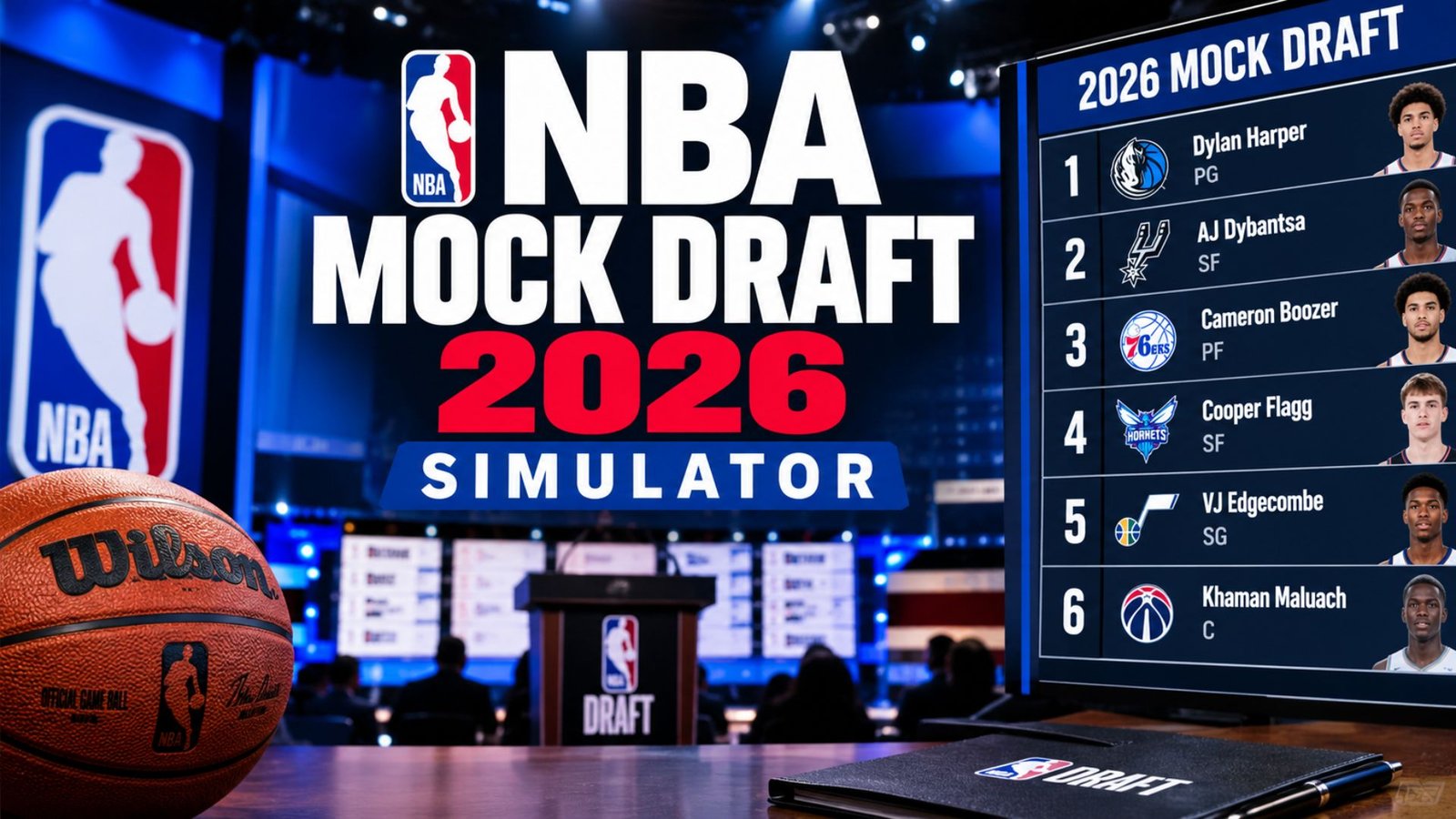
Choosing the right prospects can change an NBA franchise for years, but predicting every pick is challenging. An nba mock draft 2026 simulator helps basketball fans explore draft possibilities, compare prospects, and test different strategies. Without a clear understanding of team needs, draft order, and player development, it is easy to overlook promising talent. A simulator makes the process more interactive by letting you build your own draft board, explore trade scenarios, and see how different decisions could shape the future of the NBA.
What Is an NBA Mock Draft 2026 Simulator?
An nba mock draft 2026 simulator is an interactive basketball tool that allows fans to make draft selections, assign prospects to NBA teams, and explore alternative outcomes. Depending on the platform, users may also be able to trade draft picks, change the selection order, or complete multiple rounds.
The 2026 NBA Draft took place on June 23–24, 2026. Fans can now use a simulator to review the actual selections, compare their predictions, or create alternative drafts known as redrafts.
What Can You Do With a Draft Simulator?
- Select players for individual NBA franchises.
- Experiment with different draft strategies.
- Compare guards, forwards, and centers.
- Explore hypothetical pick exchanges.
- Build alternative first-round and second-round drafts.
- Compare your selections with the official results.
The main benefit is control. Instead of simply reading another mock draft, you can make your own choices and evaluate how they might affect a team’s future.
How to Use an NBA Mock Draft 2026 Simulator
Getting started is straightforward, even if you are new to NBA draft analysis. The exact controls depend on the simulator you choose, but most tools follow a similar process.
Step 1: Choose a Draft Format
Decide whether you want to recreate the original 2026 draft, create an alternative draft, or build a fantasy scenario with different team selections.
Step 2: Review Available Prospects
Compare player positions, college or club experience, playing style, age, and potential role before making a selection. Consider shooting, passing, defense, athletic ability, and overall versatility.
Step 3: Select Players for Teams
Match prospects to teams based on roster needs, development plans, defensive requirements, and offensive systems. A good selection should address a genuine team need while offering long-term value.
Step 4: Test Hypothetical Trades
If the simulator supports trades, exchange draft picks and evaluate whether each team receives a reasonable return. Consider future selections, player contracts, and long-term team objectives.
Step 5: Review Your Final Draft
Check every selection, compare your results with the official draft, and identify the decisions that could produce different team-building outcomes.
NBA Mock Draft 2026 Simulator With Trades
Trading makes a draft simulation more challenging because teams must balance immediate needs against long-term value. A team might move up to secure a preferred prospect, trade down to collect extra selections, or exchange a pick for an established player.
An nba mock draft 2026 simulator with trades is useful for exploring these possibilities. However, not every simulator supports transactions, and a hypothetical trade should never be confused with a real NBA deal.
Common Trade Scenarios
- Trade up: Give up additional assets to obtain an earlier selection.
- Trade down: Exchange a higher pick for a lower selection and additional compensation.
- Pick-for-player trade: Explore whether a team would prefer a veteran over a rookie.
- Future-pick trade: Consider how a future draft selection could affect long-term planning.
A realistic trade should account for contracts, team objectives, player value, and league rules. Some simulators simplify these factors, so treat their results as possibilities rather than predictions.
NBA Mock Draft 2026 Simulator Free: What to Look For
A free draft simulator can provide plenty of entertainment and analysis without requiring a paid subscription. Before using one, check which features it actually includes.
| Feature | Why It Matters | What to Check |
|---|---|---|
| Free access | Lets you experiment without paying | Whether registration is required |
| Player database | Supports informed selections | Player names, positions, and profiles |
| Team selection | Makes franchise-specific drafts possible | Coverage of all 30 NBA teams |
| Trade functionality | Adds strategic options | Whether picks and players can be exchanged |
| Multiple rounds | Supports deeper roster building | First-round and second-round coverage |
| Save or share | Preserves completed simulations | Export, sharing, or save options |
| Updated information | Helps prevent outdated selections | Current player and draft data |
Pro Tip: Before spending time on a long simulation, test whether the tool saves your selections. Some free tools allow you to finish a draft but do not preserve your results after you leave the page.
ESPN NBA Mock Draft 2026 Simulator: What Fans Should Know
Fans searching for an espn nba mock draft 2026 simulator are usually looking for an interactive ESPN experience that lets them make their own draft choices.
It is important to distinguish ESPN’s mock draft coverage and draft analysis from a fully interactive simulator. Features can change, and an article presenting projected picks does not necessarily allow users to run their own draft.
Before choosing a tool, check whether it offers:
- Interactive player selection rather than a static mock draft.
- Support for multiple NBA teams and draft rounds.
- Trade options, if you want to test transactions.
- Clear information about whether selections are projections or official results.
Searches for nba mock draft 2026 simulator espn may also lead to older pages or coverage from before the draft. Verify the page’s date and functionality instead of assuming every result is an active simulator.
Official 2026 NBA Draft Results vs. Simulator Picks
One of the most valuable ways to use a draft simulator is to compare your alternative selections with the actual 2026 NBA Draft.
The official draft board records the players selected by teams. A redraft lets you change those decisions and explore different outcomes, but it cannot establish how a player would perform under a different organization.
For accurate results, use the official NBA draft record as your reference. Check each player’s name, selection number, and draft-rights status before publishing a detailed draft table. Trades can change which team ultimately holds a player’s rights, so distinguish the team making a selection from the team receiving the player.
What Should You Compare?
- Draft position: Did your preferred player go earlier or later than expected?
- Team fit: Would the selection address an important roster need?
- Player value: Was another prospect a better option at that position?
- Trade decisions: Did a hypothetical deal provide meaningful value to both teams?
- Long-term potential: Could the selection improve the team’s future?
Comparing your draft with the official results helps you understand how different decisions affect roster construction.
Best Strategies for a Realistic NBA Mock Draft
A strong simulation considers more than a prospect’s popularity. NBA front offices evaluate how a player could contribute within a particular roster and whether the selection offers good long-term value.
1. Prioritize Team Needs
Examine each team’s roster before choosing a player. A franchise that needs a primary ball handler may value a playmaking guard, while another team may prioritize rim protection or perimeter shooting.
2. Balance Talent and Fit
The highest-ranked prospect is not always the best fit for every team. Consider shooting, defense, passing, size, versatility, and the role the player could realistically fill.
3. Evaluate Long-Term Potential
Rookies often need time to adjust to professional basketball. Consider development opportunities, playing time, skill growth, and coaching rather than expecting immediate star production.
4. Avoid Unrealistic Trades
A trade should benefit both teams for identifiable reasons. Moving up several positions may require valuable assets, while trading down may make sense for a team that wants additional picks.
5. Consider Draft Depth
The second round can offer useful prospects for teams seeking affordable talent and developmental players. Limiting your analysis to the lottery overlooks potential value later in the draft.
Key Players to Understand in a 2026 NBA Draft Redraft
The official selections offer a starting point for alternative draft exercises. Rather than treating one ranking as definitive, evaluate each player through role, skill set, development potential, and team context.
- AJ Dybantsa: A useful starting point for alternative first-pick scenarios.
- Darryn Peterson: A guard prospect to consider when comparing backcourt needs.
- Cameron Boozer: A prospect to evaluate when examining frontcourt versatility.
- Caleb Wilson: An example for comparing forward prospects and team requirements.
- Keaton Wagler: A guard prospect to assess in different draft scenarios.
- Mikel Brown Jr.: Another player to consider when evaluating backcourt options.
Verify official selections and current player information before publishing claims about draft positions or performance. These examples are starting points for analysis, not a definitive ranking of talent.
How to Evaluate Your Simulator Results
After completing a draft, assess whether your choices make sense for the teams involved. A successful simulation should explain the reasoning behind each pick instead of simply producing a list of player names.
Use this checklist to review your results:
- Team fit: Does the player address a genuine roster need?
- Player value: Was the selection reasonable compared with other available prospects?
- Positional balance: Does the team have the right mix of guards, wings, and big men?
- Development plan: Is there a realistic opportunity for the player to improve?
- Trade value: Did each team receive a fair return in a hypothetical transaction?
- Long-term outlook: Could the selection help the franchise over several seasons?
You can also score each category from 1 to 5. This creates a consistent framework for comparing different simulations, although the score remains your own evaluation rather than an official NBA rating.
NBA Draft Lottery and Pick Order Explained
The NBA Draft Lottery determines the initial positions of eligible lottery teams. It does not guarantee that a team will select a particular player, and the final order can change when teams trade draft picks or rights.
For a historical simulation, use the official 2026 lottery results and draft order. If you want to create a hypothetical scenario, clearly label any changed positions or invented lottery outcomes.
Understanding the lottery helps you distinguish between the original draft process and an alternative simulation. It also provides context for why teams with similar needs may have very different choices available to them.
Can You Use an NBA Mock Draft 2026 Simulator on Mobile?
Yes, if the chosen tool supports mobile browsers. A responsive interface should allow you to view prospects, select teams, and review your results without needing a desktop computer.
Before starting, check whether the simulator:
- Fits the screen without excessive horizontal scrolling.
- Displays player names and team selections clearly.
- Makes draft controls easy to tap.
- Preserves your selections if you switch tabs or reload.
- Works in your preferred mobile browser.
A tool that works well on a desktop may offer a different experience on a phone. Testing its controls first can save time during longer draft simulations.
How to Choose the Right NBA Draft Simulator
The best option depends on what you want to accomplish. Some fans want a quick mock draft, while others want detailed trade scenarios and a complete two-round experience.
| Your Goal | Most Useful Feature | Why |
|---|---|---|
| Make quick picks | Simple selection interface | Reduces setup time |
| Compare prospects | Player profiles and rankings | Supports informed choices |
| Explore trades | Pick and player exchanges | Tests alternative team strategies |
| Recreate 2026 | Historical draft order | Helps match the original event |
| Build a redraft | Editable selections | Allows different outcomes |
| Analyze roster needs | Team roster information | Improves player-fit decisions |
| Share results | Export or sharing features | Makes comparisons easier |
When evaluating an nba mock draft 2026 simulator, prioritize accurate player information and clear controls over flashy features. If the tool does not explain its rankings or trade assumptions, use it for entertainment rather than treating its output as expert analysis.
Common Mistakes to Avoid During a Mock Draft
Even experienced basketball fans can make unrealistic selections when they focus too heavily on individual talent.
Watch out for these common mistakes:
- Ignoring roster needs: Selecting several players at the same position can create a crowded rotation.
- Overvaluing potential: Athletic ability alone does not guarantee NBA success.
- Forgetting development time: Young players may need coaching and playing opportunities before contributing consistently.
- Making one-sided trades: A hypothetical deal should have a reasonable explanation for both teams.
- Using outdated rankings: Player evaluations can change as new performance data becomes available.
- Confusing predictions with results: A mock draft is an analysis or hypothetical exercise, not an official record.
Avoiding these mistakes makes your draft more realistic and helps you understand the decisions NBA front offices face.
Frequently Asked Questions
1. What is an NBA mock draft 2026 simulator?
An nba mock draft 2026 simulator is a tool for selecting NBA prospects, assigning players to teams, and exploring alternative draft outcomes. Depending on the platform, it may also support hypothetical trades and multiple draft rounds.
2. Is the NBA Mock Draft 2026 Simulator free?
Some draft simulators are free to use, although available features vary. Check whether the tool requires an account, limits the number of simulations, or charges for advanced trade and roster features.
3. Where can I find an ESPN NBA Mock Draft 2026 Simulator?
Search for ESPN’s NBA draft tools and coverage, then verify whether the specific page offers interactive selections or only projected picks. An ESPN mock draft article is not necessarily a simulator.
4. Can I make trades in an NBA mock draft simulator?
Yes, some simulators support hypothetical trades involving draft picks and players. If you want an nba mock draft 2026 simulator with trades, confirm that the tool supports transactions before starting.
5. Can I recreate the actual 2026 NBA Draft?
Yes. Use the official 2026 draft order and recorded selections as your reference. You can then compare your choices against the actual results or change selections to create a hypothetical redraft.
6. Which players should I consider in a 2026 NBA redraft?
Start by examining prospects such as AJ Dybantsa, Darryn Peterson, Cameron Boozer, Caleb Wilson, and Keaton Wagler. Evaluate their skills, performance, team context, and development rather than relying on draft position alone.
Conclusion: Make Your Own NBA Draft Decisions
An nba mock draft 2026 simulator gives basketball fans a practical way to explore prospect evaluations, team needs, draft strategies, and alternative outcomes. Because the 2026 NBA Draft has already concluded, the most useful approach now is to compare your selections with the official results or build a redraft that explores different possibilities.
If you prefer a free tool, focus on accessibility and accurate player information. If you want more detailed analysis, look for trade functionality, team roster data, and support for both rounds.
The best simulation is not necessarily the one that predicts every selection correctly. It is the one that explains why each pick makes sense, recognizes the limitations of player projections, and helps you think like an NBA front-office decision-maker.
Which team would you rebuild first, and what would your first-round pick be?
Share your preferred selection strategy and compare your ideas with other basketball fans.
Editorial trust note:
For factual verification, consult official NBA draft records and team announcements. Simulator rankings, hypothetical trades, and redraft outcomes should be clearly identified as analysis rather than confirmed NBA transactions.