
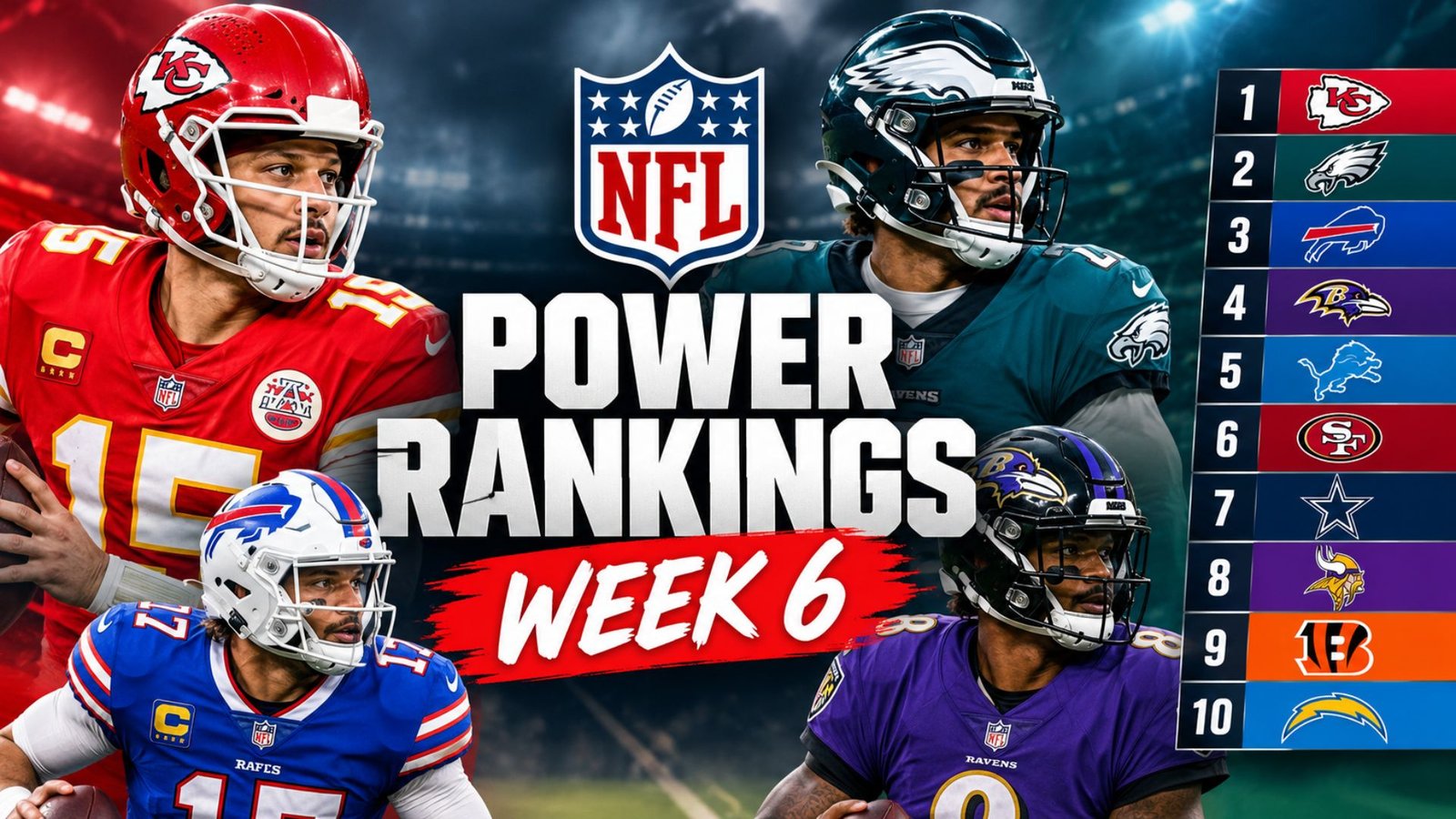
NFL fans want to know which teams look strongest, which contenders face trouble, and which underdogs could change the playoff picture. Without a clear ranking system, it can be difficult to separate genuine Super Bowl contenders from teams benefiting from an easy schedule. The NFL power rankings week 6 discussion helps readers compare team quality, recent results, offensive production, defensive consistency, and winning potential. This guide explains how rankings work, what the 2026 Week 6 picture reveals, and how to evaluate teams beyond their win-loss records.
What Are NFL Power Rankings Week 6?
NFL power rankings Week 6 compare all 32 franchises based on their overall performance rather than their positions in the official standings. Sportswriters and analysts consider recent results, strength of schedule, quarterback play, injuries, coaching decisions, and performance on both sides of the ball.
A team can rank above another franchise even with the same record. For example, a team that consistently defeats strong opponents may look more convincing than a team that narrowly beats struggling opponents.
Power rankings are not official NFL standings. They represent an analyst’s judgment about how well teams are playing and how likely they are to succeed in upcoming games.
The main factors include:
- Recent performance: Results from the latest games and the quality of those performances.
- Offensive strength: Passing efficiency, rushing production, scoring, and turnovers.
- Defensive quality: Pressure on quarterbacks, tackling, coverage, and points allowed.
- Quarterback performance: Decision-making, accuracy, mobility, and ball security.
- Injuries: The availability of key starters and the depth of the roster.
- Strength of schedule: The quality of previous and upcoming opponents.
NFL Power Rankings Week 6 2026: What Does the Latest Picture Show?
The 2026 Week 6 rankings published on October 13 evaluated teams entering the sixth week of the regular season. NFL.com placed the San Francisco 49ers first and the Kansas City Chiefs second in its rankings, with the Buffalo Bills, Jacksonville Jaguars, and Seattle Seahawks also among the leading teams in a multi-outlet comparison.
These rankings were based on games played through Week 5, so they should not be confused with an assessment made after every Week 6 game had finished.
The distinction matters because a power ranking is a snapshot of a particular moment. Injuries, unexpected defeats, and major victories can quickly change the order.
Which teams stood out before Week 6?
- San Francisco 49ers: Their strong start and defensive performance supported their position at the top of NFL.com’s rankings.
- Kansas City Chiefs: Their early-season record and balanced roster kept them among the leading contenders.
- Buffalo Bills: Quarterback Josh Allen’s ability to influence games remained a major strength.
- Jacksonville Jaguars: A winning record and competitive performances placed Jacksonville near the top.
- Seattle Seahawks: Their early results kept them in the leading group, although offensive consistency remained an important question.
These observations describe the pre-Week 6 ranking picture, not a definitive ranking after the entire week concluded.
NFL Power Rankings Week 6: Detailed Comparison Table
The following table summarizes the leading teams in the 2026 pre-Week 6 ranking picture and explains the main factors behind their positions. The ranking column follows the NFL.com order where specified; the remaining entries provide a practical comparison rather than claiming to reproduce a single publication’s complete list.
| Team | Ranking context | Main strength | Key question |
|---|---|---|---|
| San Francisco 49ers | NFL.com No. 1 | Defensive performance and team execution | Can the defense sustain its level? |
| Kansas City Chiefs | NFL.com No. 2 | Quarterback leadership and overall balance | Can the offense maintain consistency? |
| Buffalo Bills | Among the leading teams | Josh Allen’s playmaking | Can the team limit costly turnovers? |
| Jacksonville Jaguars | Among the leading teams | Competitive results and offensive potential | Can they win consistently against elite opponents? |
| Seattle Seahawks | Among the leading teams | Competitive roster and defensive potential | Can the offense improve its consistency? |
| Minnesota Vikings | Rising contender | Strong early record | Can they maintain performance against tougher opponents? |
| Baltimore Ravens | Leading contender | Experienced players and defensive ability | Can they stay healthy and finish close games? |
| Denver Broncos | Contender to monitor | Defensive potential and physical play | Can the offense deliver against top defenses? |
| New England Patriots | Team to watch | Improving results | Can the momentum continue? |
| Green Bay Packers | Team to watch | Offensive potential | Can they reduce mistakes and deliver consistently? |
Table note:
This is an editorial comparison, not a verified 1–10 consensus ranking. Exact positions vary by publisher, and the table intentionally avoids inventing precise rankings for teams whose positions are not established here.
How Do ESPN NFL Power Rankings Week 6 Compare?
ESPN NFL power rankings Week 6 are useful for readers who want a separate editorial assessment of the league. ESPN’s rankings should be compared with other publications using the same season and publication date.
Analysts may disagree about the same team because they assign different importance to recent wins, overall roster quality, injuries, and future matchups.
For a fair comparison, examine:
- The team’s position in each publication.
- Whether the team moved up or down from the previous week.
- The explanation behind its ranking.
- The quality of its recent opponents.
- Whether injuries or quarterback changes affected the assessment.
A difference of several places does not automatically mean one publication is wrong. It may reflect different interpretations of the same evidence.
NFL Power Rankings Week 6 NFL.com: What Makes Its Rankings Useful?
NFL.com publishes rankings with explanations from its writers. These explanations help readers understand why a franchise moves up or down instead of relying only on the number beside its name.
For example, a team might remain near the top after a narrow loss if it competed well against a leading opponent. Another team could fall despite winning if its offense struggled or its defense repeatedly allowed scoring opportunities.
Readers should look at both the ranking and the reasoning behind it. The explanation often provides more useful insight than a team’s numerical position alone.
Bleacher Report NFL Power Rankings Week 6
Bleacher Report offers another perspective on team performance and the wider NFL conversation. Its analysis can help readers compare how different writers assess contenders, improving teams, and franchises that have started slowly.
When reviewing Bleacher Report NFL power rankings Week 6, check the season and date before drawing conclusions. Historical rankings from 2016, 2017, 2018, 2021, or 2022 describe different rosters, coaching staffs, and competitive conditions.
A historical ranking should not be used as evidence of how a team is performing in 2026.
NFL Power Rankings Week 6 USA Today: What Should Readers Check?
USA Today is another publication readers may consult when comparing NFL teams. Its rankings can offer a different interpretation of recent performances and the league’s competitive balance.
The most useful comparison looks beyond the order of teams. Readers should check whether an analyst explains changes through quarterback performance, injuries, defensive improvements, or the strength of recent opponents.
Before quoting an exact USA Today ranking, verify the original article’s season and publication date. This prevents a historical list from being mistaken for a current ranking.
NFL Power Rankings Week 6 2025: How to Read Historical Rankings
The 2025 season provides a separate reference point for readers researching previous editions of NFL power rankings Week 6. Historical rankings help explain how public expectations changed during a season and which teams gained or lost momentum.
To evaluate the 2025 rankings properly, consider three questions:
- What was each team’s record? The record establishes the team’s results at that point in the season.
- How strong were its opponents? A winning record can be less impressive when it comes against weaker competition.
- What happened afterward? Later results can show whether an early ranking accurately identified a contender.
Do not mix 2025 rankings with 2026 rankings in one table unless the seasons are clearly labeled. Team records, rosters, and circumstances change from year to year.
NFL Power Rankings Week 6 2022, 2021, 2018, 2017, and 2016
Readers searching for older editions often want to compare team performance across different NFL seasons. The same ranking principles apply, but each year needs its own historical context.
| Search term | Best use |
|---|---|
| NFL power rankings Week 6 2022 | Research the 2022 season |
| ESPN NFL power rankings Week 6 2022 | Find ESPN’s 2022 assessment |
| NFL power rankings Week 6 2021 | Review 2021 team evaluations |
| ESPN NFL power rankings Week 6 2021 | Compare ESPN’s 2021 edition |
| NFL power rankings Week 6 2018 | Study the 2018 season |
| NFL power rankings Week 6 2017 | Review historical team expectations |
| NFL power rankings Week 6 2016 | Compare 2016 team performance |
| NFL power rankings Week 6 2011 | Research the 2011 season |
These are historical search topics, not confirmed rankings. Always match the publication, season, and week before using historical data in an article.
NFL Power Rankings Week 6 Predictions: Which Factors Matter Most?
NFL power rankings Week 6 predictions should consider more than a team’s last result. A strong forecast weighs the quality of recent performances against the challenges that lie ahead.
1. Quarterback decision-making
Quarterbacks often determine whether a promising drive becomes a touchdown or a costly turnover. Accurate passing, good reads, and smart decisions under pressure help teams perform consistently.
2. Defensive pressure
Defenses that pressure quarterbacks without exposing their secondary can disrupt even strong offenses. Sacks, hurried throws, and forced mistakes can change the outcome of close games.
3. Offensive balance
Teams that can run and pass effectively have more ways to attack opponents. A balanced offense can also reduce pressure on the quarterback in difficult situations.
4. Injury management
Missing a starting quarterback, offensive lineman, or defensive leader can change a team’s outlook. Roster depth matters because a successful season requires players to handle setbacks.
5. Strength of schedule
A team facing several leading opponents may have fewer wins than a team with an easier schedule. Analysts should consider opponent quality before making strong claims about either franchise.
6. Performance in close games
Close wins can demonstrate composure, but repeated reliance on late comebacks may also reveal weaknesses. Teams that consistently control games tend to offer a clearer picture of their underlying quality.
How to Create an Accurate NFL Power Rankings Week 6 List
A useful ranking should follow a consistent process rather than relying on personal preference.
Step 1: Record the latest results. Start with each team’s record through the relevant week and confirm the dates of completed games.
Step 2: Evaluate recent performances. Review scoring, turnovers, offensive production, defensive stops, and the quality of opponents.
Step 3: Assess the roster. Consider injuries, quarterback availability, depth, and important changes in the lineup.
Step 4: Compare the schedule. Identify whether recent victories or defeats came against strong or struggling opponents.
Step 5: Rank all 32 teams. Apply the same standards to every franchise and explain major differences in position.
Step 6: Update the rankings. Revisit the list after new results become available and explain meaningful changes.
This method makes the ranking easier to understand and gives readers reasons to trust the analysis.
Power Rankings vs. NFL Standings: What Is the Difference?
Power rankings and official standings answer different questions. Standings show a team’s competitive record, while power rankings estimate its current strength relative to the rest of the league.
| Feature | Power rankings | Official standings |
|---|---|---|
| Main purpose | Compare perceived team strength | Track competition results |
| Basis | Analysis and judgment | Wins, losses, and ties |
| Official status | Editorial | League-record based |
| Weekly changes | May reflect broader performance trends | Change when games affect records |
| Main use | Evaluate contenders and trends | Follow division and playoff positions |
A team can have a better record but a lower power ranking if analysts believe its performances are less convincing. Conversely, a team with a disappointing record may rank higher if injuries, close losses, or recent improvement suggest it could perform better going forward.
Common Mistakes When Reading NFL Power Rankings
Readers can misinterpret rankings when they focus only on the numbers.
Avoid these common mistakes:
- Treating rankings as official standings: Power rankings are opinions, not league-issued positions.
- Ignoring the publication date: A pre-Week 6 list differs from a ranking published after Week 6.
- Mixing different seasons: Historical rankings cannot accurately describe current rosters.
- Overvaluing one win: A single result rarely proves that a team is a championship contender.
- Ignoring injuries: The absence of a key player can affect performance significantly.
- Assuming every publisher agrees: ESPN, NFL.com, Bleacher Report, and USA Today may use different evaluation methods.
Understanding these limitations helps readers use rankings as analysis rather than as a guarantee of future results.
Why NFL Power Rankings Matter to Fans
Power rankings give fans a simple way to follow the league’s changing competitive picture. They help readers identify emerging contenders, monitor teams that are losing momentum, and prepare for important upcoming matchups.
They can also support fantasy football discussions and general game previews, although rankings alone cannot predict individual player statistics or the outcome of a specific game.
The best approach is to combine rankings with recent game results, player availability, matchup details, and official standings. This provides a fuller picture of what a team has achieved and what it might accomplish next.
Frequently Asked Questions
1. What are NFL power rankings Week 6?
NFL power rankings Week 6 are editorial evaluations of all 32 teams based on performance, roster quality, recent results, and future potential. They are different from official NFL standings.
2. Which team ranked No. 1 in NFL power rankings Week 6 2026?
NFL.com ranked the San Francisco 49ers No. 1 in its October 13, 2026, pre-Week 6 edition. Rankings can differ by publication and update date.
3. Where can I compare ESPN NFL power rankings Week 6?
Compare ESPN’s relevant weekly NFL analysis with the matching editions from NFL.com, Bleacher Report, and USA Today. Confirm the season and publication date to ensure a fair comparison.
4. Are NFL power rankings Week 6 predictions always accurate?
No. Rankings and predictions are informed judgments, not guarantees. Injuries, turnovers, unexpected performances, and difficult matchups can change the outcome of a game.
5. Can I find NFL power rankings Week 6 from previous seasons?
Yes. Historical searches can help locate editions from 2025, 2022, 2021, 2018, 2017, 2016, and earlier seasons. Always identify the original publisher and season.
6. What matters most when ranking NFL teams?
Recent performance, quarterback play, offensive and defensive efficiency, strength of schedule, injuries, and consistency all matter. No single statistic provides a complete measure of team strength.
Conclusion
NFL power rankings offer a useful way to understand the league’s changing competitive picture, but the most valuable analysis explains why teams deserve their positions. Comparing recent results, quarterback play, defensive performance, roster health, and opponent quality gives readers a clearer view of each franchise’s strengths and weaknesses.
For anyone following NFL power rankings Week 6, the key is to use the correct season, check publication dates, and compare multiple perspectives before drawing conclusions. Which NFL team do you believe has the strongest case to finish the season as a Super Bowl contender? Share your prediction and the evidence behind it.
2 thoughts on “NFL Power Rankings Week 6: Which Teams Rank No. 1 in 2026?”