
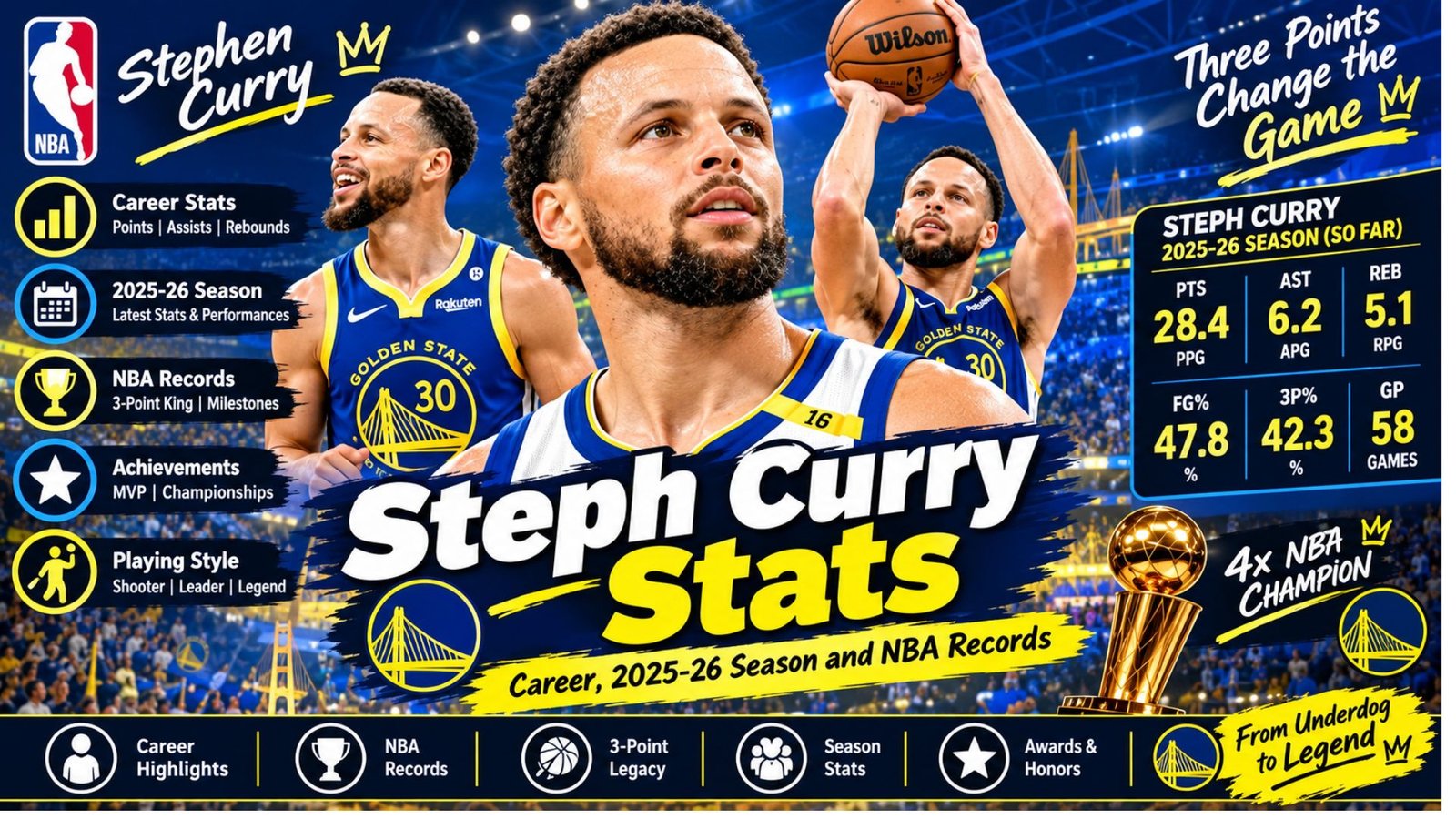
Fans checking Steph Curry stats want more than a final score. They want to know how many points Stephen Curry scored, how accurately he shot from three-point range, and how he performed against teams such as the Los Angeles Lakers, LA Clippers, and Phoenix Suns. Finding reliable numbers can be difficult when live scores, season averages, and historical records appear on different pages. This guide explains the key statistics, highlights Curry’s historic 2015–16 season, and shows how to verify the latest Golden State Warriors results.
What Are Steph Curry Stats?
Steph Curry stats describe his performance as a point guard for the Golden State Warriors in the National Basketball Association (NBA). These numbers cover scoring, assists, rebounds, shooting percentages, turnovers, steals, and three-point shooting.
His statistics help fans understand both individual performance and his contribution to team results. A high point total can show scoring ability, while strong shooting efficiency reveals how effectively he converts his opportunities.
The main statistics to check include:
- Points (PTS): Total points scored during a game or season.
- Rebounds (REB): The number of missed shots Curry recovers.
- Assists (AST): Passes that directly lead to made baskets.
- Three-pointers made (3PM): Successful shots from beyond the three-point line.
- Field-goal percentage (FG%): The percentage of all field-goal attempts that go in.
- Three-point percentage (3P%): The percentage of three-point attempts that become successful shots.
- Free-throw percentage (FT%): The percentage of free throws made.
- Turnovers (TOV): Possessions lost through errors or defensive plays.
Together, these numbers provide a clearer picture of Curry’s impact than points alone.
Steph Curry Stats This Season: What Should You Check?
To find Steph Curry stats this season, select the correct NBA season and confirm whether the figures cover regular-season games or playoff appearances.
As of October 16, 2026, the 2026–27 regular season has not yet begun. Therefore, regular-season totals for that season should not be presented as completed results. Preseason performances, previous-season statistics, and regular-season averages are different categories.
Use the following checklist when reviewing the latest figures:
- Confirm the season shown on the statistics page.
- Check how many games Curry has played.
- Compare his points, assists, and rebounds per game.
- Review his three-point attempts and accuracy.
- Check injury reports and game availability separately.
- Confirm the date and opponent of his most recent game.
The official NBA player statistics page is the best starting point for current and historical records.
Steph Curry Stats: Career Performance at a Glance
Curry built his reputation through exceptional shooting, off-ball movement, and the ability to score from long range. His performance has also included playmaking, free-throw accuracy, and scoring in high-pressure situations.
The table below summarizes important career milestones and the numbers that make his record notable.
| Career achievement | Verified detail | Why it matters |
|---|---|---|
| NBA team | Golden State Warriors | Identifies his NBA franchise |
| Position | Guard | Explains his scoring and playmaking role |
| NBA debut | 2009 | Marks the beginning of his NBA career |
| NBA championships | 4 | Reflects team success |
| Regular-season MVP awards | 2 | Recognizes individual excellence |
| NBA Finals MVP | 2022 | Recognizes his Finals performance |
| Three-pointers in 2015–16 | 402 | Set a then-record single-season mark |
| Points per game in 2015–16 | 30.1 | Highlights his scoring production that season |
These milestones are historical records, not a substitute for his current-season averages. The NBA’s official player profile provides his biography and career achievements.
Steph Curry Stats 3-Pointers: Why They Matter
Three-point shooting is central to Curry’s offensive game. He can score from well beyond the arc, force defenders to cover more space, and create driving lanes for teammates.
However, the number of made three-pointers does not tell the entire story. Fans should compare makes, attempts, and shooting percentage to understand his performance.
For example, a player who makes six three-pointers on 12 attempts has a 50% three-point percentage. A player who makes the same six shots on 18 attempts has a 33.3% percentage.
The most useful three-point measures are:
- 3PM: Total successful three-point shots.
- 3PA: Total three-point attempts.
- 3P%: Three-pointers made divided by attempts, multiplied by 100.
- Three-point points: Each successful three-pointer contributes three points to the score.
Curry made 402 three-pointers during the 2015–16 regular season, a landmark achievement in NBA history. When searching for Steph Curry stats 3 pointers, check whether the source reports regular-season totals, playoff totals, or combined figures.
2016 Steph Curry Stats: A Historic Season
The 2015–16 campaign remains one of Curry’s most celebrated seasons. He won the NBA regular-season MVP award unanimously and helped the Warriors finish with a 73–9 regular-season record.
His regular-season production included the following figures:
| Statistic | 2015–16 regular-season result |
|---|---|
| Games played | 79 |
| Points per game | 30.1 |
| Rebounds per game | 5.4 |
| Assists per game | 6.7 |
| Field-goal percentage | 50.4% |
| Three-pointers made | 402 |
| Three-point percentage | 45.4% |
| Free-throw percentage | 90.8% |
These figures demonstrate why 2016 remains a key reference point when evaluating Steph Curry stats. He combined high scoring volume with outstanding shooting accuracy.
The Warriors eventually lost the NBA Finals to the Cleveland Cavaliers after leading the series 3–1. That result does not diminish the statistical significance of Curry’s regular season.
Steph Curry Stats Tonight and Last Night
Fans searching for Steph Curry stats tonight or Steph Curry stats last night usually want a recent box score rather than season averages.
A complete game report should include:
| Game statistic | What to record |
|---|---|
| Opponent | Team the Warriors played |
| Final score | Points scored by both teams |
| Minutes | Time Curry spent on the court |
| Points | Total points scored |
| Rebounds | Offensive and defensive rebounds |
| Assists | Passes leading directly to baskets |
| Field goals | Makes and attempts |
| Three-pointers | Makes, attempts, and percentage |
| Free throws | Makes and attempts |
| Turnovers | Possessions lost |
| Plus/minus | Team scoring margin while he played |
If Curry did not play, a reliable report should say so rather than treating missing statistics as zero-point performance.
For a live result, check the NBA game center or official box score. If no game has taken place on the requested date, the most recent completed game is the appropriate comparison.
Steph Curry Stats Last 5 Games and Last 10 Games
Recent game logs help fans identify trends that season averages may hide. A five-game sample can reveal a short scoring surge, while a ten-game sample provides a somewhat broader view.
When examining Steph Curry stats last 5 games or Steph Curry stats last 10 games, compare the following measures:
- Average points per game.
- Total and average three-pointers made.
- Three-point shooting percentage.
- Assists and turnovers.
- Minutes played per game.
- Games missed or limited by injury.
Do not confuse a total with an average. If Curry scores 120 points over five games, his scoring average for that stretch is 24 points per game.
Short stretches can also be misleading. Shooting percentages may change sharply over a few games, so compare recent performance with the full-season numbers before deciding that his form has improved or declined.
Steph Curry Stats vs Lakers and Clippers
Matchup statistics show how Curry performs against specific opponents. Searches such as Steph Curry stats vs Lakers and Steph Curry stats vs Clippers should use the correct date range and season.
The most useful comparisons include points, three-pointers, assists, shooting percentage, turnovers, and minutes played.
| Matchup | Statistics to review | Important context |
|---|---|---|
| Los Angeles Lakers | Points, 3PM, assists, FG% | Defensive pressure and pace |
| LA Clippers | Points, 3PM, rebounds, turnovers | Defensive matchups and available players |
| Phoenix Suns | Points, assists, 3P% | Opponent lineup and shot selection |
| Denver Nuggets | Points, rebounds, assists | Defensive coverage and team pace |
| Houston Rockets | Points, assists, turnovers | Pressure on the ball and game tempo |
| San Antonio Spurs | Points, 3PM, assists | Defensive scheme and shooting opportunities |
| Oklahoma City Thunder | Points, 3P%, turnovers | Perimeter defense and possession control |
| Orlando Magic | Points, assists, FG% | Matchup assignments and game conditions |
| Minnesota Timberwolves | Points, 3PM, assists | Perimeter pressure and rim protection |
This table is a matchup research guide, not a claim that Curry has recorded any particular average against these teams. For accurate comparisons, use official game logs and apply the same season or date range to every opponent.
How to Read Curry’s Game-by-Game Performance
A box score becomes more useful when you understand how its numbers work together. A high-scoring game can still include inefficient shooting, while a lower-scoring performance may involve excellent passing and ball control.
Consider these three questions:
Did Curry score efficiently? Compare field-goal percentage and three-point percentage with his attempts. High volume and strong accuracy indicate productive scoring.
Did he create opportunities for teammates? Assists show direct playmaking, while turnovers help explain the cost of handling the ball.
Did his minutes affect the result? A player who spends fewer minutes on the court may record lower totals without necessarily playing poorly.
Advanced measures, such as true shooting percentage, include two-point shots, three-pointers, and free throws in a broader scoring-efficiency calculation. These metrics help fans compare performances more fairly.
Where to Find Accurate Steph Curry Stats
Use trusted sources and verify the reporting period before publishing statistics.
- NBA.com: Official player profiles, traditional statistics, advanced metrics, and game logs.
- Basketball-Reference: Historical season tables, per-game averages, playoff records, and career comparisons.
- Golden State Warriors: Team news, injury updates, game reports, and official announcements.
- NBA game center: Live scores and completed-game box scores.
For a reliable article, record the date you checked the data and distinguish regular-season statistics from playoff results. If sources disagree, review their season filters and definitions before choosing a figure.
What Makes Steph Curry’s Statistics Unique?
Curry’s influence extends beyond the number of shots he makes. Defenders often follow him away from the basket because of his shooting range, which can open space for teammates to attack.
His movement without the ball also matters. Screens, quick changes of direction, and the threat of an immediate shot can disrupt defensive positioning even when he does not receive the pass.
His numbers should therefore be evaluated through three connected elements:
- Scoring: Points, shooting attempts, and efficiency.
- Playmaking: Assists, turnovers, and the space he creates for teammates.
- Team impact: Lineup performance, opponent strategy, and the Warriors’ overall result.
This wider approach offers a more complete picture than relying on a single scoring total.
Conclusion
Steph Curry stats tell the story of one of basketball’s most influential shooters, from his historic 402 three-pointers in 2015–16 to the game-by-game figures that help fans assess his latest performances. The most useful analysis combines points, assists, rebounds, shooting percentages, and opponent context.
For accurate updates, start with official NBA records, check the date and season, and separate historical achievements from current results. Which Curry statistic interests you most: three-pointers, scoring averages, or performance against a particular NBA team?
Frequently Asked Questions
1. Where can I find Steph Curry stats tonight?
Check the official NBA game center and Stephen Curry’s NBA player page. If a game is in progress, use the live box score; otherwise, review his most recent completed game.
2. What were Steph Curry’s stats in the 2015–16 season?
Curry averaged 30.1 points, 5.4 rebounds, and 6.7 assists per game in the 2015–16 regular season. He also made 402 three-pointers and shot 45.4% from beyond the arc.
3. How many three-pointers did Steph Curry make in 2016?
Curry made 402 three-pointers during the 2015–16 NBA regular season. This was a record at the time and helped define his historic MVP campaign.
4. How do I check Steph Curry stats in his last 10 games?
Open an up-to-date game-log source and select the latest ten completed games. Compare points, assists, rebounds, three-pointers, shooting percentages, and minutes to understand his recent performance.
5. Where can I find Steph Curry stats vs Lakers or Clippers?
Use NBA.com’s player statistics and game logs to identify games against the Los Angeles Lakers or LA Clippers. Apply a consistent season or date range and compare the same statistics for each matchup.
6. Are Steph Curry’s regular-season and playoff stats the same?
No. Regular-season and playoff statistics cover different games and should be reported separately. Always check the season type before comparing averages or totals.
2 thoughts on “Steph Curry Stats: What Do His Numbers Reveal?”