
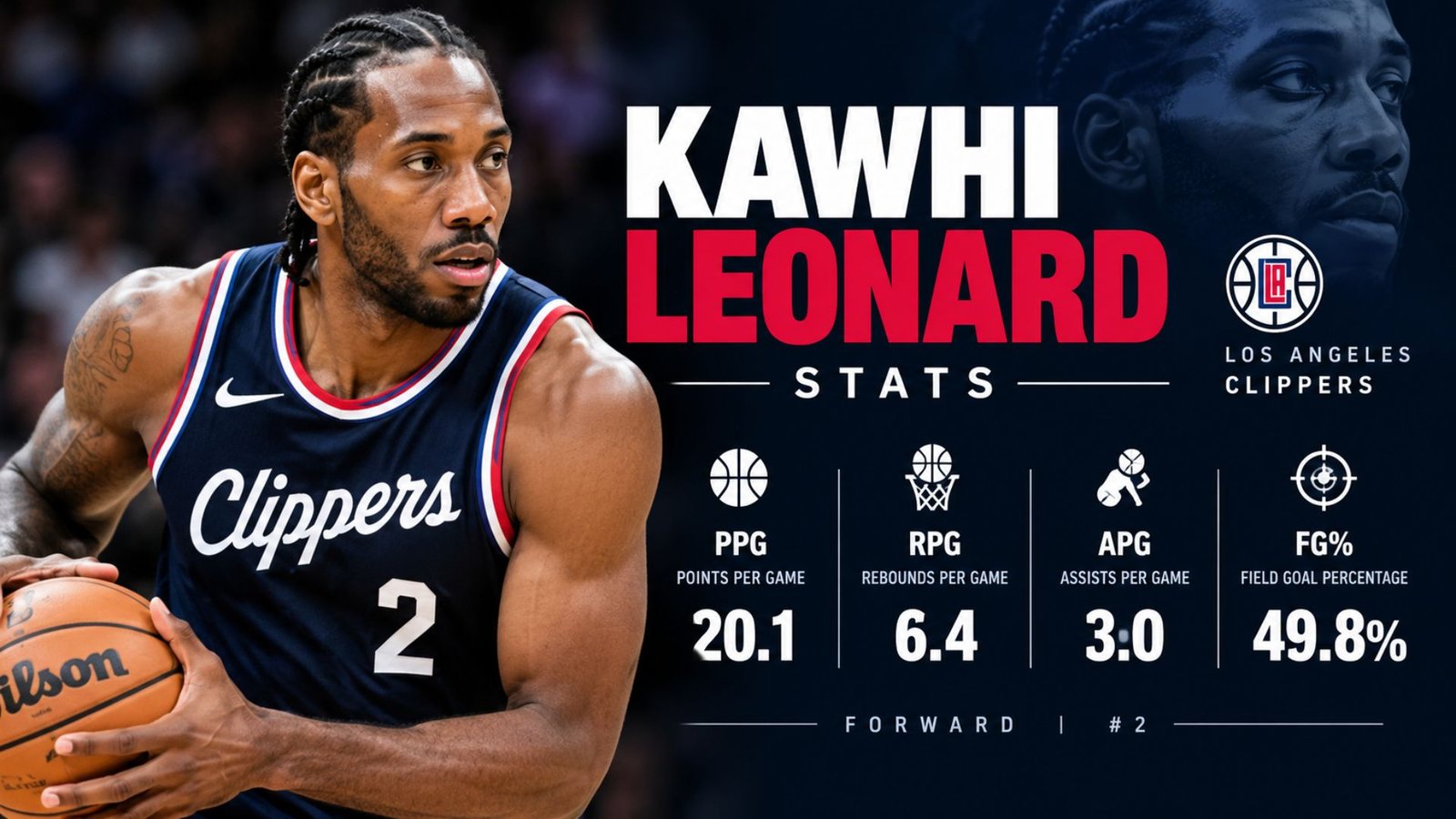
Want to know what Kawhi Leonard’s numbers reveal about his performance on the basketball court? Kawhi Leonard stats help readers evaluate his scoring, rebounding, playmaking, shooting efficiency, and defensive contributions. His performance can vary depending on the opponent, game situation, playing time, and shooting opportunities. Looking beyond points alone provides a more complete understanding of his value to the LA Clippers and helps basketball fans compare his performances across different games and seasons.
Kawhi Leonard Stats: 2025–26 Season Overview
Kawhi Leonard’s 2025–26 regular-season performance can be evaluated through several important statistical categories. Points per game measure his scoring output, rebounds reflect his ability to secure possession, and assists show how frequently he creates scoring opportunities for teammates.
The following table presents the season figures used in this article. Verify these numbers against official NBA statistics before publication.
| Statistical Category | 2025–26 Average |
|---|---|
| Points per game | 27.9 |
| Rebounds per game | 6.4 |
| Assists per game | 3.6 |
| Steals per game | 1.9 |
| Blocks per game | 0.4 |
| Minutes per game | 32.1 |
| Field-goal percentage | 50.5% |
| Three-point percentage | 38.7% |
| Free-throw percentage | 89.2% |
| Games played | 65 |
These figures suggest that Leonard contributed across several areas rather than relying exclusively on scoring. His shooting percentages also help explain his offensive efficiency, although shot attempts and the difficulty of individual shots provide additional context.
How Did Kawhi Leonard Perform in His Last Five Games?
Recent game statistics provide a snapshot of a player’s short-term form. Reviewing points, rebounds, and assists together can reveal whether a player contributes consistently across multiple categories.
The following table presents the five-game sample used for this analysis.
| Date | Opponent | Points | Rebounds | Assists | Result |
|---|---|---|---|---|---|
| April 15, 2026 | Golden State Warriors | 21 | 7 | 3 | Loss |
| April 10, 2026 | Portland Trail Blazers | 24 | 8 | 5 | Loss |
| April 8, 2026 | Oklahoma City Thunder | 20 | 8 | 3 | Loss |
| April 7, 2026 | Dallas Mavericks | 34 | 4 | 3 | Win |
| April 5, 2026 | Sacramento Kings | 26 | 6 | 3 | Win |
Across this sample, Leonard averaged 25.0 points, 6.6 rebounds, and 3.4 assists per game. He scored at least 20 points in every listed appearance and reached 34 points against Dallas.
These results illustrate the value of examining individual performances alongside season averages. However, a five-game sample cannot reliably predict future performances or establish a long-term trend.
What Do Kawhi Leonard’s Scoring Stats Tell Us?
Leonard’s scoring statistics help explain his offensive role. He can contribute through midrange jump shots, drives toward the basket, three-point attempts, and free throws.
When analyzing his scoring, consider these categories:
- Points per game: Measures average scoring output.
- Field-goal percentage: Shows the proportion of field-goal attempts that become successful shots.
- Three-point percentage: Measures accuracy from beyond the three-point line.
- Free-throw percentage: Shows how effectively he converts free throws.
- Shot attempts: Helps explain how many opportunities he needs to produce his points.
A player who scores 30 points efficiently may have a different statistical profile from one who needs considerably more attempts to reach the same total. Comparing several categories gives readers a clearer picture of offensive performance.
Why Are Kawhi Leonard’s Rebounds and Assists Important?
Rebounds and assists reveal contributions that points alone cannot capture. Leonard’s rebounding average helps explain his ability to secure possession, while his assists measure passes directly credited with a teammate’s successful field goal.
These categories also provide useful context when his scoring decreases. A lower-scoring performance can still include valuable rebounding and playmaking, particularly when the opposing defense limits his shooting opportunities.
Readers should examine these statistics alongside turnovers and minutes played to understand how effectively he contributes during a game.
How Effective Is Kawhi Leonard on Defense?
Leonard’s defensive performance deserves attention alongside his offensive production. Steals and blocks provide measurable evidence of certain defensive actions, but they do not capture every contribution.
Defensive positioning, contested shots, communication, switches, and limiting opponents’ opportunities also matter. A player may influence an opponent’s decisions without recording a steal or block.
For a balanced evaluation, compare multiple defensive metrics and consider the role Leonard played against the opposing team’s leading scorers.
Kawhi Leonard Stats Tonight: What Should You Check?
Fans searching for Kawhi Leonard stats tonight should confirm the date and status of the relevant game. Live statistics change throughout a game, and completed box scores can differ substantially from season averages.
Use this checklist when reviewing current results:
- Confirm that Leonard is scheduled to play or has appeared in the game.
- Check his points, rebounds, assists, steals, and blocks.
- Review his minutes and shooting attempts.
- Confirm whether the figures describe the regular season or playoffs.
- Compare the performance with his season averages.
The 2025–26 figures discussed in this article are historical season statistics. They should not be presented as his current 2026–27 averages without updated verification.
Kawhi Leonard Stats vs Warriors
Leonard’s performance against the Golden State Warriors on April 15, 2026, provides an example of an opponent-specific result. In the game listed in this article’s sample, he recorded 21 points, seven rebounds, and three assists.
However, one game does not establish his overall average against Golden State. A reliable matchup analysis requires all eligible appearances from the selected period.
When examining Kawhi Leonard stats vs Warriors, compare scoring, shooting percentages, rebounds, assists, and turnovers. State clearly whether the analysis covers one game, one season, or his career.
Kawhi Leonard Stats vs Lakers
Researching Kawhi Leonard stats vs Lakers requires the same careful approach. Begin by identifying the season and selecting the games played against the Los Angeles Lakers.
Useful categories include points, rebounds, assists, field-goal percentage, three-point percentage, and turnovers. Comparing these figures with his overall season averages can help determine whether his performance against the Lakers was above or below his usual level.
Avoid drawing broad conclusions from a single matchup, particularly when playing time or availability differs between games.
Kawhi Leonard Stats vs Kings, Rockets, and Other Opponents
Opponent-specific statistics help basketball fans compare Leonard’s performances against different teams. Relevant matchups include the Sacramento Kings, Houston Rockets, New York Knicks, Denver Nuggets, Philadelphia 76ers, San Antonio Spurs, Utah Jazz, Portland Trail Blazers, Oklahoma City Thunder, Indiana Pacers, and Detroit Pistons.
For each opponent, identify the period before calculating averages. Career statistics may differ substantially from single-season results, while a small number of appearances can make an average less representative.
A useful matchup table should include the opponent, games played, points per game, rebounds per game, assists per game, and shooting percentages. Every value should come from a verified game log rather than an estimate.
Kawhi Leonard Stats Last 10 Games vs Last 5 Games
A five-game sample provides a quick snapshot of recent performance, while a ten-game sample includes more appearances and may offer a broader view of short-term consistency.
For Kawhi Leonard stats last 10 games, calculate his average points, rebounds, assists, and shooting percentages across the ten most recent eligible appearances. Repeat the process for his last five games to compare the shorter period with the broader sample.
Follow these guidelines:
- Use the same competition and season type.
- Count games played rather than games scheduled.
- Calculate shooting percentages from total successful attempts divided by total attempts.
- Include the dates covered by each sample.
- Compare recent figures with season averages.
The five-game sample presented above averages 25.0 points, 6.6 rebounds, and 3.4 assists. A current ten-game average requires a complete, updated set of game statistics.
How to Read Kawhi Leonard’s Game Log Correctly
A game log records individual performances and allows readers to compare results over time. It commonly includes minutes, points, field goals, three-pointers, free throws, rebounds, assists, steals, blocks, turnovers, and plus-minus.
Three details deserve particular attention.
Minutes played: More playing time generally creates more opportunities to accumulate statistics.
Shooting attempts: Field-goal percentage becomes more informative when considered alongside shot volume and shot selection.
Plus-minus: This statistic records the team’s scoring margin while a player is on the court. It does not independently measure that player’s total impact.
Understanding these details helps readers evaluate performances more accurately than simply comparing point totals.
Which Statistics Best Measure Kawhi Leonard’s Overall Performance?
No single statistic captures every aspect of Leonard’s contribution. A comprehensive evaluation combines scoring, efficiency, rebounding, playmaking, defense, and playing time.
| Metric | What It Measures | Why It Matters |
|---|---|---|
| Points per game | Scoring production | Evaluates offensive output |
| Field-goal percentage | Overall shooting accuracy | Provides efficiency context |
| Three-point percentage | Long-range shooting | Measures perimeter accuracy |
| Rebounds per game | Rebounding contribution | Shows possession recovery |
| Assists per game | Passing that creates scores | Reflects playmaking |
| Steals per game | Recorded steals | Indicates certain defensive plays |
| Turnovers | Lost possessions | Helps evaluate ball security |
| Minutes per game | Playing time | Adds context to other averages |
Combining these measures provides a more complete understanding of Leonard’s performance and makes comparisons between games more meaningful.
Frequently Asked Questions
1. What were Kawhi Leonard’s stats in the 2025–26 season?
The season figures used in this article list Leonard at 27.9 points, 6.4 rebounds, and 3.6 assists per game. They also list shooting percentages of 50.5% from the field, 38.7% from three-point range, and 89.2% from the free-throw line. Verify the figures before publication.
2. How can I check Kawhi Leonard stats tonight?
Check the latest game box score and confirm the date, game status, and competition. Points, rebounds, assists, shooting percentages, and minutes provide a useful overview of his performance.
3. How many points did Kawhi Leonard score in the last game listed in this article?
The latest game in the five-game sample is dated April 15, 2026, against the Golden State Warriors. The table lists him with 21 points, seven rebounds, and three assists.
4. How can I compare Kawhi Leonard stats vs Lakers and Warriors?
Identify the relevant games against each team, then calculate averages for the same season or career period. Comparing points, rebounds, assists, and shooting efficiency makes the analysis more meaningful.
5. What is the difference between last-five-game and last-ten-game statistics?
Last-five-game statistics cover five recent appearances, while last-ten-game statistics cover ten. The shorter sample highlights recent changes more quickly, but it can also be more affected by unusually strong or weak performances.
6. Are Kawhi Leonard’s 2025–26 statistics his current-season numbers?
No. The 2025–26 statistics describe that completed regular season. His 2026–27 averages must be calculated from the current season’s verified game results.
Conclusion
Kawhi Leonard’s statistics provide valuable insight into his scoring, shooting efficiency, rebounding, playmaking, and defensive contributions. Examining individual games alongside season averages helps readers understand his performance without relying on points alone.
For the most accurate analysis, verify the latest game log, identify the correct season, and compare multiple statistical categories. Which matters most when evaluating Leonard: scoring consistency, shooting efficiency, rebounding, playmaking, or defense?
1 thought on “Kawhi Leonard Stats: What Do His Numbers Reveal?”